This webpage lists studies that are currently accepting applications. Click on a green bar to learn more about the study and how to participate.
On February 4, 2025, the Alberta Government announced the creation of a new income support program, the “Alberta Disability Assistance Program” (ADAP) along with new employment supports. While details are yet to be confirmed, ADAP will be for low-income Albertans with disabilities “who are able work”. ADAP will exist alongside the Assured Income for the Severely Handicapped (AISH) program—the longstanding income assistance program for persons with severe and permanent disabilities in Alberta. ADAP is scheduled to launch in July 2026.
The purpose of this study is to examine the impact of ADAP and resultant employment impacts on income assistance clients and persons with disabilities. This study will also examine whether and how different measures of poverty can be used to improve policy design and evaluation in Alberta and Canada.
The University of Calgary Conjoint Faculties Research Ethics Board has approved this research study (REB25-1727).
Who is eligible to participate?
- Between 18 and 64 years old,
- Living in Alberta, and
- Either receiving income assistance (AISH, Income Support, or ADAP) or living with a disability
What will I be asked to do?
- Participants will be asked to answer a survey every six months ending December 2028.
- The survey questions are on: basic demographics, disability type and severity, employment situation, and ability to meet their and their households needs.
- Personal questions will be asked including questions about gender, income, culture, education, family composition, employment, disability type and severity, whether participants have/can access certain items and services, and their housing situation.
- Caregivers, support persons, and legal guardians are welcome to help eligible participants complete the survey. This can include reading questions aloud, helping fill in the answers, or supporting communication in another way. The decision to take part should always be made by the person themselves, and they can stop at any time.
How can I participate?
If you would like to participate, fill out the indication of interest form. For questions or to learn more, please e-mail Dr. Lindsay Tedds at lindsay.tedds1@ucalgary.ca.
To view the research study, please click on the poster.

Expressions of interest to participate will be accepted until April 30, 2026.
Researchers at University of Calgary are seeking volunteers to participate in a research project aimed at exploring the experiences of late-diagnosed Autistic people in job interviews. Autistic people experience much higher rates of underemployment, and job interviews are often one of the biggest obstacles.
Many programs have been created to help Autistic people learn interview skills, but these programs are usually designed without meaningful Autistic input. Because of that, they often teach Autistic people to hide or change their natural ways of communicating in order to seem more “neurotypical.” This is known as social camouflaging, and it can be harmful to Autistic people’s mental health and sense of identity.
This study aims to reorient the research on autism and job interviews such that emphasis is given to exploring the lived experiences of Autistic people.
The University of Calgary Conjoint Faculties Research Ethics Board has approved this research study (REB22-1575).
Who is eligible to participate?
- Autistic adults with a formal or self-diagnosis, whose diagnosis/discovery occurred in adulthood (18 years of age or older).
- Participated in at least one job interview in the last year, and the interview must have occurred since their autism diagnosis/discovery.
What will I be asked to do?
- You will be asked to complete a short survey, questionnaire, and an hour long interview. Participants will be compensated with a $25.00 gift card.
How can I participate?
If you would like to participate or need more information, please contact Bethany Torraville at bethany.torraville@ucalgary.ca. Expressions of interest to participate will be accepted until April 2026.
To view the research poster, click on the image.

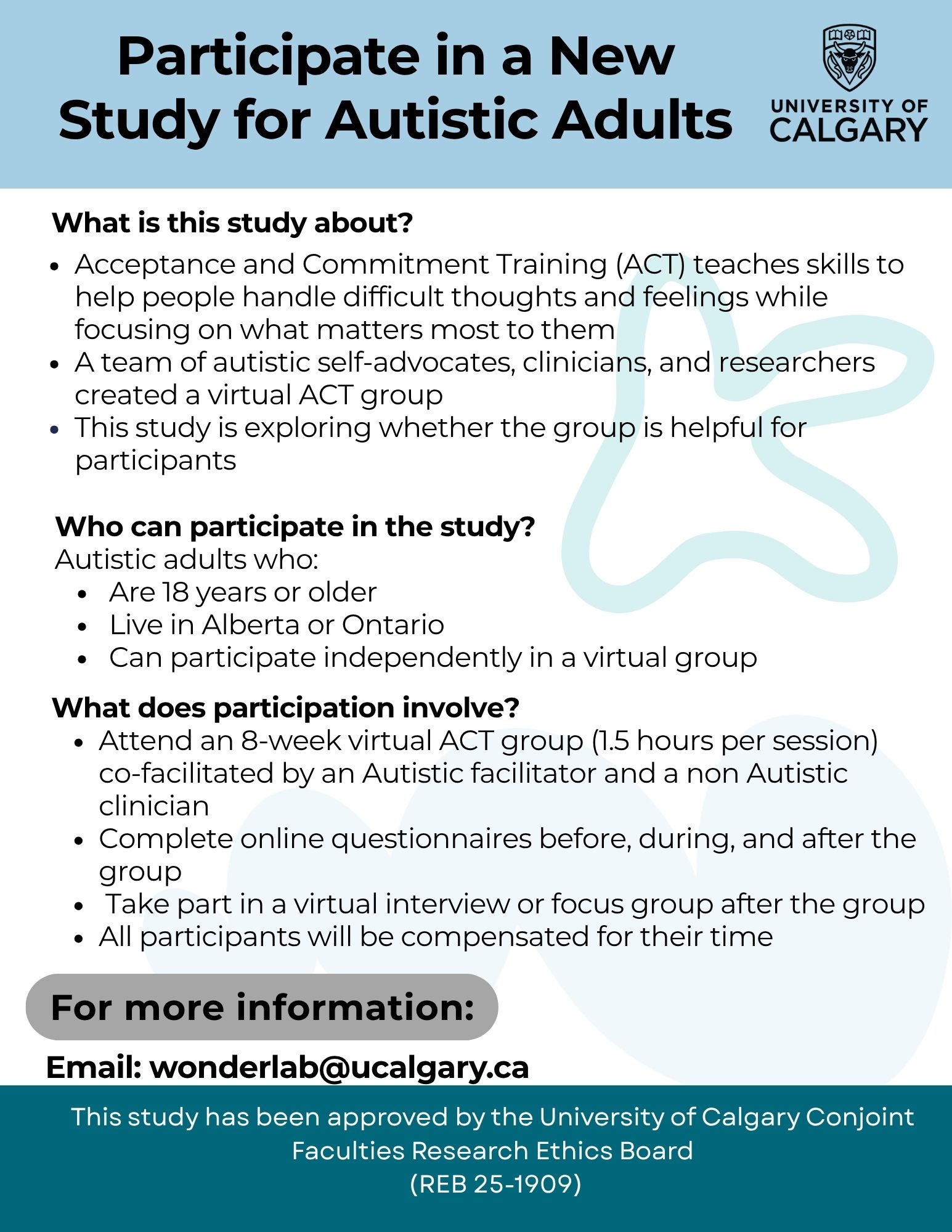
The research team at University of Calgary (led by Dr. Ami Tint) are conducting a virtual study to better understand how they can adapt mental health supports to meet the needs of neurodivergent family caregivers of neurodivergent people. Specifically, they are planning to adapt the Caring for the Caregiver (CC-ACT) program for neurodivergent caregivers and seek your input on how best to achieve this.
This study has been approved by the University of Calgary Conjoint Faculties Research Ethics Board (REB 25-1804).
Who is eligible to participate?
- Family caregivers of people with neurodevelopmental conditions,
- Identify as neurodivergent,
- 18+ years of age,
- Currently reside in Canada.
What will I be asked to do?
- Participate in a virtual interview. As a token of appreciation, you will receive an honorarium for your time, and a chance to improve supports for caregivers like yourself.
How can I participate?
If you would like to participate or need more information, please contact Dr. Ami Tint at wonderlab@ucalgary.ca. Expressions of interest to participate will be accepted until April 2026.
To view the research poster, click on the image.

The Autism Research Lab at the University of New Brunswick is recruiting adults who either have a formal diagnosis of autism or personally identify as Autistic for participation in an online survey looking at self-compassion, mental health, self-stigma, and attitudes towards psychological counselling.
Self-compassion has emerged as healthy practice for improving mental health in Autistic adults; however, there is limited research examining how self-compassion relates to Autistic adult’s experiences of self-stigma (the internalization of negative stereotypes and prejudicial beliefs about autism) and attitudes towards receiving professional mental health support. The researchers are hoping to address this knowledge gap through this research to inform the development of mental health interventions tailored to meet the needs of Autistic adults.
This study has been reviewed by the University of New Brunswick’s Research Ethics Board and is on file as REB 2025-246.
Who is eligible to participate?
- You identify as Autistic (formal diagnosis of Autism is not required),
- Not have a co-occurring intellectual disability,
- Be 19+ years of age and older.
What will I be asked to do?
- Answer questions through an online survey expected to take around 30 minutes to complete. As a token of appreciation, you will be entered into a draw to win 1 of 5 CAD $25.00 dollar Amazon gift cards.
How can I participate?
If you would like to participate, complete the online survey. If you need more information, please contact Benjamin Mersereau at ben.kitts.mersereau@unb.ca. Expressions of interest to participate will be accepted until April 2026.
To view the research poster, click on the image.

Researchers at Precision Medicine in Autism and the University of Alberta are conducting a study on identifying the challenges and opportunities for implementing a standard of care genetic testing for autism and neurodevelopmental conditions.
This study aims to understand the experiences and opinions of people on the autism spectrum, their families, and the physicians who care for them on genetic testing for autism. The goal is to identify barriers to genetic testing and find ways to improve patient care and the healthcare system in Alberta for those on the spectrum.
University of Alberta has approved this study (REB ID – Pro00145198).
Who is eligible to participate?
- Individuals who have received a formal diagnosis of autism and their families and reside in Alberta
- Physicians who practice in Alberta and care for individuals on the autism spectrum
What will I be asked to do?
- Once you consent to be in the study, you will be asked to complete an online survey. The survey includes questions about your experiences and perspectives on genetic testing for autism and will take approximately 20-30 minutes to complete.
- You may be contacted again after you completed the survey to participate in a one-on-one interview. This interview will ask more in-depth questions about your experiences and perspectives on genetic testing for autism. The interview will take no more than 60 minutes.
How can I participate?
Learn more about the study to see if you are interested in participating in the study.
If you are interested in participating in this study, please contact Dr. Daniel Moreno De Luca or the PRISMA research staff at prisma@ualberta.ca or call (780) 492-4467. Expressions of interest to participate will be accepted until December 2026.
To view the research poster, click on the image.